


Home | Products | Rotary Airlock Valves | Quick Take Apart Series Rotary Airlock Valve

Válvula de esclusa rotativa de la serie Quick Take Apart

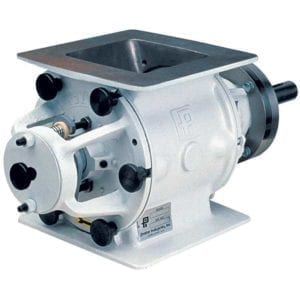
Quick Take Apart Rotary Airlock Valve for Fast Cleaning and Compact Installations

Bulk material processing systems often require rotary airlock valves that can be serviced quickly without extensive disassembly. The Prater Quick-Take-Apart (QTA) Series Rotary Airlock Valve is engineered for these environments, allowing operators to remove the rotor and end plate as a single assembly for rapid cleaning, inspection, or maintenance.

Unlike conventional rotary valves that require careful re-gapping of the rotor during reassembly, the QTA Series eliminates this step through its integrated design. This helps maintenance teams return the valve to service faster while maintaining proper rotor clearances and reliable air sealing.

Constructed from cast iron or stainless steel, the QTA rotary airlock is designed to withstand industrial environments while maintaining precise internal tolerances. Standard configurations include eight-blade rotors, direct-drive gear motors operating at 9, 15, or 23 RPM, and operating capabilities up to approximately 500°F and ±12 PSI pressure differential.

Because it provides quick access to internal components in a compact footprint without the additional rail system, the Quick-Take-Apart Series is well suited for processing lines where frequent cleaning, product changeovers, or maintenance access is required but installation space is limited.

Válvula de esclusa rotativa

CARACTERÍSTICAS Y BENEFICIOS:

  • Temperaturas de hasta 500°F
  • Hasta +/- 12 PSI de presión diferencial
  • Construcción de hierro fundido o acero inoxidable
  • Motorreductores de accionamiento directo (9, 15, 23 RPM)
  • Rotores de ocho hojas
  • Extracción del rotor sin herramientas
  • Sizes 6 and 8 inch square

Request a Custom Quote

Share your requirements, and our engineers will deliver a customized recommendation with pricing and lead times.

Frequently Asked Questions

How does the Quick-Take-Apart rotary airlock simplify maintenance?
The rotor and end plate can be removed together as a single assembly without specialized tools. This design allows operators to inspect or clean internal components quickly while reducing maintenance downtime.

Why does the QTA design eliminate the need to gap the rotor during reassembly?
Traditional rotary valves often require technicians to manually reset rotor clearances during reassembly. The QTA design removes this step by allowing the rotor assembly to be removed and replaced as one unit while preserving factory-set tolerances.

When should the standard QTA valve be selected instead of the rail-mounted model?
The standard Quick-Take-Apart valve is typically selected when equipment space is limited or when a rail system cannot be installed. It provides the same quick-access maintenance benefits but in a more compact design.

What operating conditions can the QTA Series rotary airlock handle?
The valve is designed for temperatures up to approximately 500°F and pressure differentials up to about ±12 PSI, allowing it to function reliably in many bulk material handling and pneumatic conveying applications.

What types of materials can be processed through a Quick-Take-Apart rotary airlock?
Common materials include dry bulk products such as coffee, grains, cornmeal, starch, sugar, salt, sulfur, fly ash, and similar powders or granules used in industrial processing systems.

¿NO ESTÁ SEGURO DEL TAMAÑO DE LA ESCLUSA QUE NECESITA?

Pruebe nuestra herramienta de recomendación del tamaño de la esclusa: responda a unas sencillas preguntas y le recomendaremos el tamaño de la esclusa que debe utilizar.

OBTENER EL TAMAÑO DE LA ESCLUSA

La esclusa rotativa de la serie QTA puede gestionar fácilmente muchos tipos de café molido o instantáneo, maíz y harina de maíz enteros o agrietados, semillas de lino, cenizas volantes, grano, avena entera o laminada, carbonato de potasio, sal, soja, almidón, azúcar, azufre y muchos otros. A continuación se presentan otras aplicaciones y materiales diferentes, como la alúmina amoniacal, el cemento, el carbón vegetal, ejemplos de materiales que se han alimentado a través de nuestras esclusas rotativas QTA:

  • Polvo A.B.S.
  • Copos de acetato
  • Alúmina de amonio
  • Atomita
  • Bicarbonato de sodio
  • Bauxita
  • Hueso (molido grueso)
  • Harina de huesos
  • Bórax en polvo
  • Pastel (Copra Ground)
  • Carbonato de calcio
  • Negro de humo
  • Carbón en polvo (activado)
  • Cemento
  • Carbón vegetal (molido)
  • Polvo de carbón
  • Carbón (pulverizado)
  • Coco (rallado o en escamas)
  • Café (molido)
  • Café (instantáneo)
  • Maíz (agrietado)
  • Harina de maíz
  • Maíz (entero)
  • Polvo de Cremora
  • Fosfato dicálcico
  • Hojas de Digitalis
  • Fosfato disódico
  • Mezcla de donuts
  • Farina
  • Harina de pescado
  • Desechos de pescado
  • Semillas de lino
  • Flock (Celulosa)
  • Harina (de trigo)
  • Cenizas volantes
  • Germen (maíz)
  • Gilsonita
  • Comida con gluten
  • Grano (cerveceros)
  • Sémola (maíz)
  • Comida de maíz
  • Habas (enteras)
  • Hielo (triturado)
  • Pigmento de tinta
  • Pigmento de óxido de hierro
  • Arcilla de caolín
  • Lactosa
  • Cal (hidratada)
  • Malamina en polvo
  • Leche (en polvo)
  • Mostaza en polvo
  • Semilla de mostaza (sin moler)
  • Avena (laminada)
  • Avena (entera)
  • Comida de naranja
  • Cacahuetes (crudos)
  • Cacahuetes (tostados)
  • Pebblelime
  • Resina de polímero
  • Carbonato de potasio
  • Madera para pasta (astillas)
  • Arroz (descascarillado)
  • Sal (granulada de calidad alimentaria)
  • Sal (roca)
  • Semonlina
  • Ceniza de sosa (carbonato de sodio)
  • Pirofosfato ácido de sodio
  • Sulfato de sodio
  • Solubles (Brewer Dried)
  • Copos de soja (crudos)
  • Copos de soja (gastados)
  • Harina de soja
  • Especias
  • Almidón (granulado)
  • Almidón (en polvo)
  • Azúcar (granulado)
  • Azúcar (en polvo)
  • Ácido sulfámico
  • Azufre (molido)
  • Polvo de talco
  • Hojas de té (secas)
  • Hojas de té (húmedas gastadas)
  • Dióxido de titanio (TiO2)
  • Tabaco (molido)
  • Tallos de tabaco (picados)
  • Vermiculita (expandida)
  • Vinilo (Regrind)
  • Salvado de trigo
  • Trigo (Buck)
  • Trigo (craqueado)
  • Trigo (integral)
  • Astillas de madera (secas)
  • Óxido de zinc


TECHNICAL GUIDE

Validate your airlock specification

Series selection logic, displacement data, and Test Lab validation. The framework for matching an airlock to your exact process conditions.
DOWNLOAD THE GUIDE
SELF-ASSESSMENT

Get a configured valve spec

Tell us your material, operating environment, and system health. Our engineers return a configured valve specification within one business day.
START THE ASSESSMENT