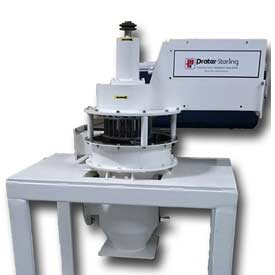
MAC Air Classifier for Precision Fine Particle Separation
For manufacturers processing fine powders and dry bulk materials, controlling particle size distribution is essential for maintaining product quality and process efficiency. The Prater MAC Air Classifier is a forced-vortex classification system designed to deliver exceptionally precise particle separation across a wide range of feed variations. By combining adjustable centrifugal force with controlled airflow, the system separates particles based on size and density to produce uniform, high-quality material streams.
The MAC Air Classifier is capable of separating particles within a typical range of approximately 3 to 150 microns, making it well-suited for applications that require ultra-fine classification and narrow particle size distributions. The machine can operate either as a stand-alone classification system with feeder, fan, and collection equipment or as part of a closed-circuit grinding system integrated with milling equipment.
Its heavy-duty construction, precision rotor design, and adjustable secondary air stream allow operators to fine-tune the cut point and capture near-size particles efficiently, helping manufacturers achieve consistent material specifications across industries such as food processing, chemicals, minerals, and advanced materials manufacturing.
HAUPTMERKMALE UND VORTEILE
HD-Konstruktion aus Kohlenstoffstahl oder Edelstahl
Präzisionsrotor mit konstantem Durchmesser für hervorragende Schnittschärfe
Präzise Steuerung des Schnittpunkts im Strom durch einfache Änderung der Rotordrehzahl
Einstellbares Sekundärluftsystem für eine bessere Erfassung von Partikeln in der Nähe der Größe
Geringer Systemwiderstand für weniger Stromverbrauch
Wahlweise Keramik-, Wolfram-, Polyurethan- oder Gummiauskleidung für abrasiven Einsatz
Request a Custom Quote
Share your requirements, and our engineers will deliver a customized recommendation with pricing and lead times.
Theorie der Arbeitsweise
Prater MAC-Luftsichter nutzen eine einstellbare Zentrifugalkraft, um Partikel in einem pneumatischen Kreislauf zu trennen. Wenn das Produkt durch den primären Lufteinlass befördert wird, werden die einzelnen Partikel von der pneumatischen Luft einem aerodynamischen Widerstand ausgesetzt. Diese Widerstandskraft variiert mit der Größe und Dichte der einzelnen Partikel. Während sich die Partikel spiralförmig auf den Sichterrotor zubewegen, geschieht eines von zwei Dingen:
die Luftwiderstandskraft kleinerer, aerodynamischer Partikel die vom Rotor ausgeübte Zentrifugalkraft übersteigt und die Partikel als Feingut durch die Maschine gelangen; oder
Die Zentrifugalkraft überwindet die Widerstandskraft, wodurch größere, weniger aerodynamische Partikel vom Rotor weg beschleunigt werden, wo eine Zyklonkammer die groben Partikel auffängt und durch eine am Boden der Maschine angebrachte Rotationsschleuse ausschleust.
Der Schnittpunkt wird bestimmt, wenn die Kräfte gleich sind. In diesem Fall haben die Partikel eine 50/50-Chance, als Feingut durchzugehen. Der Trennpunkt ist variabel und kann durch Anpassung der Rotordrehzahl gesteuert werden. Ein sekundärer Lufteinlass führt eine steuerbare Luftmenge ein, die sich nach oben in die Klassifizierungszone bewegt und die Verweilzeit von agglomerierten und größennahen Partikeln verlängert. Diese Luft trägt dazu bei, die Abscheideleistung für das gewünschte Produkt zu erhöhen.
Frequently Asked Questions
What is the Prater MAC Air Classifier used for? The MAC Air Classifier is designed to separate dry bulk materials by particle size and density using centrifugal force and airflow. It is commonly used to produce narrow particle size distributions for fine powders and industrial bulk solids processing.
What particle size range can the MAC Air Classifier separate? The MAC Air Classifier typically separates particles in the range of approximately 3 to 150 microns, depending on material characteristics and operating parameters.
How does the MAC Air Classifier work? Material enters the classification chamber where airflow and centrifugal force act on each particle. Finer particles are carried through the classifier as product fines, while larger particles are rejected and discharged through a collection chamber.
Can the MAC Air Classifier be integrated into existing processing systems? Yes. The system can operate as a stand-alone classifier or be integrated into closed-circuit grinding systems with milling equipment to continuously remove correctly sized particles while recirculating oversized material.
What materials can be processed in a MAC Air Classifier? The MAC Air Classifier processes a wide range of dry bulk materials including chemicals, minerals, food ingredients, graphite, carbon, calcium compounds, and other powders requiring precise particle separation.
Nachfolgend finden Sie eine Auswahl von Materialien, die in unseren Windsichtern verwendet wurden (beachten Sie, dass es noch weitere trockene, rieselfähige Materialien gibt, die problemlos in unseren Windsichtern verarbeitet werden können und die hier nicht aufgeführt sind):
Mandelschalen
Aluminium-Oxid
Ammoniumsalz
Calcit
Calciumcarbonat, Calciumhydroxid, Calciumoxid, Calciumsilikat, Calciumstearat und Calciumwolframat
Kohlenstoff
Schwarzer Kohlenstoff
Chemikalien
Kohlenstaub
Kakaopulver
Maisfasern, Maismehl, Maisstärke und Maissirupfeststoffe