


Home | Products | Rotary Airlock Valves | Quick Take Apart Series Rotary Airlock Valve

Schnell zerlegbare Schleusendrehventile der Serie

Quick Take Apart Rotary Airlock Valve for Fast Cleaning and Compact Installations

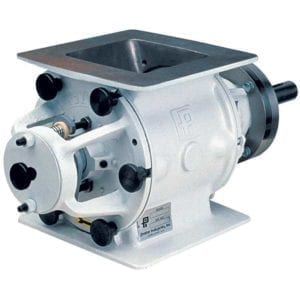
Bulk material processing systems often require rotary airlock valves that can be serviced quickly without extensive disassembly. The Prater Quick-Take-Apart (QTA) Series Rotary Airlock Valve is engineered for these environments, allowing operators to remove the rotor and end plate as a single assembly for rapid cleaning, inspection, or maintenance.

Unlike conventional rotary valves that require careful re-gapping of the rotor during reassembly, the QTA Series eliminates this step through its integrated design. This helps maintenance teams return the valve to service faster while maintaining proper rotor clearances and reliable air sealing.

Constructed from cast iron or stainless steel, the QTA rotary airlock is designed to withstand industrial environments while maintaining precise internal tolerances. Standard configurations include eight-blade rotors, direct-drive gear motors operating at 9, 15, or 23 RPM, and operating capabilities up to approximately 500°F and ±12 PSI pressure differential.

Because it provides quick access to internal components in a compact footprint without the additional rail system, the Quick-Take-Apart Series is well suited for processing lines where frequent cleaning, product changeovers, or maintenance access is required but installation space is limited.

Schleusendrehventil

MERKMALE UND VORTEILE:

  • Temperaturen bis zu 500°F
  • Bis zu +/- 12 PSI Druckdifferenz
  • Konstruktion aus Gusseisen oder Edelstahl
  • Getriebemotoren mit Direktantrieb (9, 15, 23 RPM)
  • Acht-Blatt-Rotoren
  • Werkzeugloser Ausbau des Rotors
  • Größen 6 und 8 Zoll quadratisch

Request a Custom Quote

Share your requirements, and our engineers will deliver a customized recommendation with pricing and lead times.

Frequently Asked Questions

How does the Quick-Take-Apart rotary airlock simplify maintenance?
The rotor and end plate can be removed together as a single assembly without specialized tools. This design allows operators to inspect or clean internal components quickly while reducing maintenance downtime.

Why does the QTA design eliminate the need to gap the rotor during reassembly?
Traditional rotary valves often require technicians to manually reset rotor clearances during reassembly. The QTA design removes this step by allowing the rotor assembly to be removed and replaced as one unit while preserving factory-set tolerances.

When should the standard QTA valve be selected instead of the rail-mounted model?
The standard Quick-Take-Apart valve is typically selected when equipment space is limited or when a rail system cannot be installed. It provides the same quick-access maintenance benefits but in a more compact design.

What operating conditions can the QTA Series rotary airlock handle?
The valve is designed for temperatures up to approximately 500°F and pressure differentials up to about ±12 PSI, allowing it to function reliably in many bulk material handling and pneumatic conveying applications.

What types of materials can be processed through a Quick-Take-Apart rotary airlock?
Common materials include dry bulk products such as coffee, grains, cornmeal, starch, sugar, salt, sulfur, fly ash, and similar powders or granules used in industrial processing systems.

SIE SIND SICH NICHT SICHER, WELCHE GRÖSSE DER LUFTSCHLEUSE SIE BENÖTIGEN?

Testen Sie unser Tool zur Empfehlung der Luftschleusengröße: Beantworten Sie ein paar einfache Fragen, und wir geben Ihnen eine Empfehlung für die richtige Luftschleusengröße.

LUFTSCHLEUSENAUSLEGUNG ERHALTEN

Die Zellenradschleuse der QTA-Serie kann problemlos eine Vielzahl von gemahlenem oder Instant-Kaffee, ganzem oder geknacktem Mais und Maismehl, Leinsamen, Flugasche, Getreide, ganzem oder gewalztem Hafer, Kaliumcarbonat, Salz, Sojabohnen, Stärke, Zucker, Schwefel und vielen anderen Materialien verarbeiten. Hier finden Sie einige weitere Anwendungen und Materialien, darunter Ammoniumaluminiumoxid, Zement, Holzkohle und einige andere Materialien, die durch unsere QTA-Drehschleusen geleitet wurden:

  • A.B.S.-Pulver
  • Acetat-Flocke
  • Ammonium-Tonerde
  • Atomit
  • Backpulver
  • Bauxit
  • Knochen (grob gemahlen)
  • Knochenmehl
  • Borax-Pulver
  • Kuchen (Kopra gemahlen)
  • Kalziumkarbonat
  • Schwarzer Kohlenstoff
  • Kohlepulver (Aktivkohle)
  • Zement
  • Holzkohle (gemahlen)
  • Kohlenstaub
  • Steinkohle (pulverisiert)
  • Kokosnuss (geraspelt oder in Flocken)
  • Kaffee (gemahlen)
  • Kaffee (Instant)
  • Mais (geknackt)
  • Maismehl
  • Mais (ganz)
  • Cremora-Pulver
  • Dicalciumphosphat
  • Digitalis-Blätter
  • Dinatriumphosphat
  • Donut-Mix
  • Farina
  • Fischmehl
  • Fischabfälle
  • Leinsamen
  • Flock (Zellulose)
  • Mehl (Weizen)
  • Flugasche
  • Keim (Mais)
  • Gilsonit
  • Gluten-Mahlzeit
  • Getreide (Bierbrauer)
  • Grits (Mais)
  • Maisbrei-Mahlzeit
  • Maisbrei (ganz)
  • Eis (zerkleinert)
  • Tintenpigment
  • Eisenoxid-Pigment
  • Kaolin-Ton
  • Laktose
  • Kalk (hydratisiert)
  • Malamin-Pulver
  • Milch (pulverisiert)
  • Senfpulver
  • Senfkörner (ungemahlen)
  • Hafer (gewalzt)
  • Hafer (ganz)
  • Orangenmahlzeit
  • Erdnüsse (roh)
  • Erdnüsse (geröstet)
  • Kieselkalk
  • Polymer-Harz
  • Kaliumkarbonat
  • Zellstoffholz (Hackschnitzel)
  • Reis (geschält)
  • Salz (granuliert, Lebensmittelqualität)
  • Salz (Stein)
  • Semonlina
  • Soda-Asche (Natriumkarbonat)
  • Natriumpyrophosphat
  • Natriumsulfat
  • Lösliche Bestandteile (getrocknete Biere)
  • Sojaflocken (roh)
  • Sojaflocken (verbraucht)
  • Sojabohnenmehl
  • Gewürze
  • Stärke (granuliert)
  • Stärke (pulverisiert)
  • Zucker (granuliert)
  • Zucker (pulverisiert)
  • Sulfaminsäure
  • Schwefel (gemahlen)
  • Talkum-Pulver
  • Teeblätter (trocken)
  • Teeblätter (nass verbraucht)
  • Titaniumdioxid (TiO2)
  • Tabak (gemahlen)
  • Tabakstängel (zerkleinert)
  • Vermiculit (expandiert)
  • Vinyl (Regrind)
  • Weizenkleie
  • Weizen (Buck)
  • Weizen (geknackt)
  • Weizen (Vollkorn)
  • Holzspäne (trocken)
  • Zinkoxid