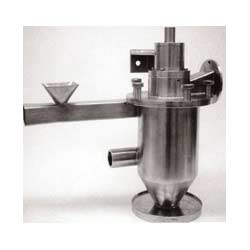
Precision Air Classification for Ultra-Fine Particle Separation
In bulk material processing, achieving a precise particle size distribution is critical for product quality, downstream efficiency, and process stability. Prater Air Classifiers provide a highly controlled method of separating dry materials by particle size and density using adjustable centrifugal force and aerodynamic airflow. These systems deliver ultra-fine particle separation—typically within a range of approximately 3 to 150 microns—while maintaining narrow particle distributions and consistent throughput.
Engineered for demanding industrial environments, Prater Air Classifiers integrate easily into both stand-alone classification processes and closed-circuit grinding systems, enabling manufacturers to precisely control particle fineness while improving system efficiency. Their robust design, adjustable rotor speed, and secondary airflow control allow operators to fine-tune the cut point for a wide range of materials used in food processing, minerals, chemicals, and other bulk solids industries.
Features:
Operating range of 1 to 75 Microns
Feed rate for 1 to 75 kilograms/hour
Narrow size distributions
Stainless steel contact parts
Versatile, heavy-duty design, and vibration-free
Air purged bearings, easy disassembly, high throughput
Request a Custom Quote
Share your requirements, and our engineers will deliver a customized recommendation with pricing and lead times.
The Mini-split Air Classifiers were primarily developed for research in "semi-tech" and small-scale production applications. An ideal choice for small workspaces, its low-noise capabilities reduce distractions while its compact size ensures efficient portability. This unique design is flexible enough for lab applications and rugged enough to meet small production requirements.
All contact parts of the Mini-split Air Classifier are made from stainless steel, which helps to reduce maintenance costs and downtime while increasing operational life. The unit can be easily converted into an opposed jet fluid energy micronizing system with an integral classifier. Operating under suction, Prater units always work to promote a dust-free environment. The capacities of feed and finished product bins can be adjusted to meet individual customer requirements for a truly customized machine that works with your specific needs.
Frequently Asked Questions
What is an air classifier used for in industrial processing? An air classifier separates dry particles by size and density using airflow and centrifugal force rather than screens. This allows manufacturers to achieve very fine particle separation and narrow particle size distributions in bulk material processing systems.
How does an air classifier work? Air classifiers introduce feed material into a classification chamber where airflow and centrifugal force act on each particle. Smaller or lighter particles are carried through the system as fines, while larger particles are rejected and recirculated or discharged as coarse material.
What particle size range can an air classifier separate? Industrial air classifiers typically separate particles within a range of approximately 3 to 150 microns, depending on the machine configuration, material properties, and operating parameters.
What industries commonly use air classification equipment? Air classifiers are used across industries including food processing, chemical manufacturing, minerals and mining, pharmaceuticals, and advanced materials where precise particle size control is required for product quality and performance.
Can air classifiers be integrated with grinding systems? Yes. Air classifiers are commonly installed in closed-circuit grinding systems with mills or pulverizers to continuously remove properly sized particles while recirculating oversized material for further size reduction.
Here are the following types of material that have been used in our air classifier (keep in mind that there are more dry free-flowing materials that can be easily processed in our air classifier that are not listed below):