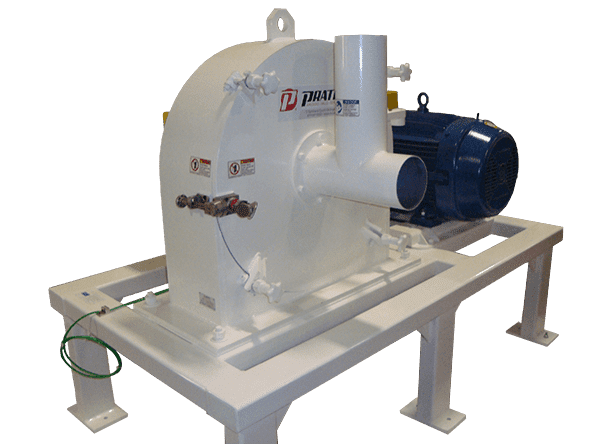
M Series Fine Grinder for High-Efficiency Particle Size Reduction
Achieving a precise particle size distribution is critical for manufacturers processing powders, chemicals, food ingredients, and other bulk materials. The Prater M Series Fine Grinder is engineered to grind dry, free-flowing materials into uniform fine powders while maintaining tight control of particle size and throughput. Designed for high-efficiency impact grinding, the system reduces materials to a final particle size range of approximately 60 to 400 mesh (250 to 37 microns) while maintaining a narrow particle distribution.
Prater’s fine grinding mills operate on a high-speed impact principle, where feed material enters the grinding chamber and is accelerated by rotor blades, creating repeated impact and shear against stationary grinding elements and screens until the desired particle size is achieved.
Available in multiple configurations—from pilot-scale laboratory mills to large industrial production models—the M Series Fine Grinder offers greater capacity, improved dust control, and simplified maintenance, making it well-suited for processing heat-sensitive materials such as resins, sugars, and powder coatings.
Request a Custom Quote
Share your requirements, and our engineers will deliver a customized recommendation with pricing and lead times.
FEATURES
Final product size 60 – 400 mesh
External bearing assembly
Dynamically balanced reversible rotor assembly
Tight clearances between rotor & fixed grinding elements
Dual O-ring door seal with floating door hinge for a positive seal
Replaceable grinding blades
Sanitary construction available
BENEFITS
More capacity
Better dust control
Precise control of finished particle size and distribution
Simple maintenance
Standard safety features
Prater Fine Grinders (M Series Mills) are designed to grind dry, free-flowing material as fine as 400 mesh (37 microns) with a very tight distribution of particle size. The highly efficient design allows for ease of access to all internals and is well suited for heat-sensitive materials such as resins and sugar. Six sizes are available from the 3 HP M-19 bench-scale lab mill to the 250 HP M-101.
A close tolerance between the rotor blades and the grinding jaw/screen frame assembly are designed to produce a more uniform and finer grind. The larger screen to horsepower ratio allows for more capacity. Dual “O” rings seals on the large access door and outboard bearings allow for better dust control. Removing one bolt allows quick removal of the rotor, which is reversible. Rotor blades are easily replaced without further rotor balancing needed.
Prater Fine Grinders utilize a high-speed impact principle. The feed material is metered into the center of the mill, where it is impacted by the rotor. The feed material is then thrown outward where it impacts with other particles, aiding in the reduction process. After initial impact, particles are projected across the screen and are sheared between the blades of the rotor and the sizing screen or jaws. This action continues until the particles are properly sized and are discharged through the bottom of the mill. Precision tolerances are maintained between the rotor blades and the stationary grinding surfaces to allow for precise control of finished particle size and distribution.
All Prater Fine Grinders come with an automatic door interlock. This device prevents access to mill internals during operation and prevents dangerous motion during access.
*Do not use for engineering purposes. Please request a certified drawing for all layout or construction uses.
Frequently Asked Questions
What is the Prater M Series Fine Grinder used for? The M Series Fine Grinder is used to reduce dry, free-flowing materials into fine powders with a tight particle size distribution. It is commonly used in bulk material processing applications where precise particle sizing is required.
What particle size can the M Series Fine Grinder produce? The grinder typically produces particles ranging from 60 to 400 mesh (250 to 37 microns), depending on the material properties and mill configuration.
How does the M Series Fine Grinder work? The grinder uses a high-speed impact grinding principle. Material enters the grinding chamber, where rotor blades accelerate particles and force them against stationary grinding surfaces and screens until they reach the required size.
What materials can be processed with a fine grinding mill? Fine grinding mills are commonly used for processing dry, free-flowing materials such as resins, sugars, minerals, powder coatings, and other bulk powders that require consistent particle size reduction.
What features help maintain consistent particle size distribution? The M Series Fine Grinder uses tight clearances between rotor blades and stationary grinding elements, along with interchangeable screens and grinding components, to maintain uniform particle size and narrow distributions.