


Home | Products | Rotary Airlock Valves | Quick Take Apart Series Rotary Airlock Valve

Quick Take Apart Series Rotary Airlock Valve

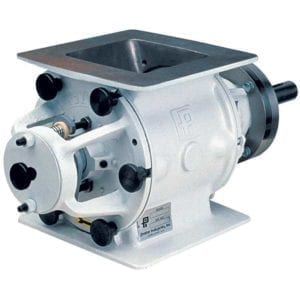
Quick Take Apart Rotary Airlock Valve for Fast Cleaning and Compact Installations

Bulk material processing systems often require rotary airlock valves that can be serviced quickly without extensive disassembly. The Prater Quick-Take-Apart (QTA) Series Rotary Airlock Valve is engineered for these environments, allowing operators to remove the rotor and end plate as a single assembly for rapid cleaning, inspection, or maintenance.

Unlike conventional rotary valves that require careful re-gapping of the rotor during reassembly, the QTA Series eliminates this step through its integrated design. This helps maintenance teams return the valve to service faster while maintaining proper rotor clearances and reliable air sealing.

Constructed from cast iron or stainless steel, the QTA rotary airlock is designed to withstand industrial environments while maintaining precise internal tolerances. Standard configurations include eight-blade rotors, direct-drive gear motors operating at 9, 15, or 23 RPM, and operating capabilities up to approximately 500°F and ±12 PSI pressure differential.

Because it provides quick access to internal components in a compact footprint without the additional rail system, the Quick-Take-Apart Series is well suited for processing lines where frequent cleaning, product changeovers, or maintenance access is required but installation space is limited.

Rotary Airlock Valve

FEATURES & BENEFITS:

  • Temperatures up to 500°F
  • Up to +/- 12 PSI pressure differential
  • Cast iron or stainless construction
  • Direct drive gear-motors (9, 15, 23 RPM)
  • Eight-blade rotors
  • Tool-less removal of rotor
  • Sizes 6 and 8 inch square

Request a Custom Quote

Share your requirements, and our engineers will deliver a customized recommendation with pricing and lead times.

Frequently Asked Questions

How does the Quick-Take-Apart rotary airlock simplify maintenance?
The rotor and end plate can be removed together as a single assembly without specialized tools. This design allows operators to inspect or clean internal components quickly while reducing maintenance downtime.

Why does the QTA design eliminate the need to gap the rotor during reassembly?
Traditional rotary valves often require technicians to manually reset rotor clearances during reassembly. The QTA design removes this step by allowing the rotor assembly to be removed and replaced as one unit while preserving factory-set tolerances.

When should the standard QTA valve be selected instead of the rail-mounted model?
The standard Quick-Take-Apart valve is typically selected when equipment space is limited or when a rail system cannot be installed. It provides the same quick-access maintenance benefits but in a more compact design.

What operating conditions can the QTA Series rotary airlock handle?
The valve is designed for temperatures up to approximately 500°F and pressure differentials up to about ±12 PSI, allowing it to function reliably in many bulk material handling and pneumatic conveying applications.

What types of materials can be processed through a Quick-Take-Apart rotary airlock?
Common materials include dry bulk products such as coffee, grains, cornmeal, starch, sugar, salt, sulfur, fly ash, and similar powders or granules used in industrial processing systems.

NOT SURE WHAT SIZE AIRLOCK YOU NEED?

Try our Airlock Size Recommendation Tool: answer a few simple questions and we’ll provide a recommendation on what size airlock to use.

GET AIRLOCK SIZING

The QTA Series rotary airlock can easily manage many dground or instant coffee, whole or cracked corn and cornmeal, flax seed, fly ash, grain, whole or rolled oats, potassium carbonate, salt, soybeans, starch, sugar, sulfur, and many others. Here are some more exifferent applications and materials, including ammonium alumina, cement, charcoal, amples of materials that have been feed through our QTA rotary airlocks:

  • A.B.S. Powder
  • Acetate Flake
  • Ammonium Alumina
  • Atomite
  • Baking Soda
  • Bauxite
  • Bone (Coarse Ground)
  • Bone Meal
  • Borax Powder
  • Cake (Copra Ground)
  • Calcium Carbonate
  • Carbon Black
  • Carbon Powder (Activated)
  • Cement
  • Charcoal (Ground)
  • Coal Dust
  • Coal (Pulverized)
  • Coconut (Shredded or Flake)
  • Coffee (Ground)
  • Coffee (Instant)
  • Corn (Cracked)
  • Corn Meal
  • Corn (Whole)
  • Cremora Powder
  • Dicalcium Phosphate
  • Digitalis Leaves
  • Disodium Phosphate
  • Donut Mix
  • Farina
  • Fish Meal
  • Fish Scrap
  • Flax Seed
  • Flock (Cellulose)
  • Flour (Wheat)
  • Fly Ash
  • Germ (Corn)
  • Gilsonite
  • Gluten Meal
  • Grain (Brewers)
  • Grits (Corn)
  • Hominy Meal
  • Hominy (Whole)
  • Ice (Crushed)
  • Ink Pigment
  • Iron Oxide Pigment
  • Kaolin Clay
  • Lactose
  • Lime (Hydrated)
  • Malamine Powder
  • Milk (Powdered)
  • Mustard Powder
  • Mustard Seed (Unground)
  • Oats (Rolled)
  • Oats (Whole)
  • Orange Meal
  • Peanuts (Raw)
  • Peanuts (Roasted)
  • Pebblelime
  • Polymer Resin
  • Potassium Carbonate
  • Pulpwood (Chips)
  • Rice (Hulled)
  • Salt (Granulated Food Grade)
  • Salt (Rock)
  • Semonlina
  • Soda Ash (Sodium Carbonate)
  • Sodium Acid Pyrophospate
  • Sodium Sulfate
  • Solubles (Brewer Dried)
  • Soybean Flakes (Raw)
  • Soybean Flakes (Spent)
  • Soybean Meal
  • Spices
  • Starch (Granulated)
  • Starch (Powdered)
  • Sugar (Granulated)
  • Sugar (Powdered)
  • Sulfamic Acid
  • Sulfur (Ground)
  • Talcum Powder
  • Tea Leaves (Dry)
  • Tea Leaves (Spent Wet)
  • Titanium Dioxide (TiO2)
  • Tobacco (Ground)
  • Tobacco Stems (Chopped)
  • Vermiculite (Expanded)
  • Vinyl (Regrind)
  • Wheat Bran
  • Wheat (Buck)
  • Wheat (Cracked)
  • Wheat (Whole Grain)
  • Wood Chips (Dry)
  • Zinc Oxide