

Prater offers a wide range of sizing and separation solutions based on customers’ needs. We focus on vibratory (deck) screeners, rotary (centrifugal) sifters, and air classifiers.
Prater Particle Sizing & Separation Products
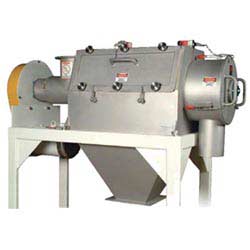
Rotary Sifters
High capacity sifting and scalping at rates many times greater than conventional sifters with a similar screen area. The unique centrifugal force imparted by adjustable paddles, in combination with flexible mesh fabrics, greatly reduces binding problems when handling materials containing high fats/oils. A three-bearing design ensures smooth, vibration-free operation and long life.
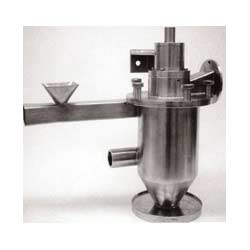
Minisplit Air Classifier
The Mini-split Air Classifiers were primarily developed for research “semi-tech” and small-scale production applications. An ideal choice for small workspaces, its low-noise capabilities reduce distractions while its compact size ensures efficient portability.
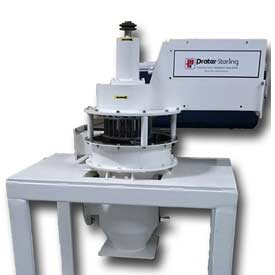
Mac Air Classifier
The MAC forced vortex units process dry materials to an unmatched fineness and uniformity over a wide range of feed variations, either in closed-circuit with a conventional milling system or as independent “stand-alone” systems that incorporate feeder, fan and product collection equipment.
Prater Sizing & Separation Case Studies
- Screen Design Solutions for the Powder Coating Industry
- Sifting System Solutions for the Cocoa Industry
Need Help Finding Your Solution?
Frequently Asked Questions
What is particle sizing and separation in industrial processing?
Particle sizing and separation is the process of classifying bulk materials by particle size or removing unwanted contaminants from a product stream. Manufacturers use screening, sifting, and air classification technologies to achieve consistent particle distribution and improve product quality.
What types of equipment are used for particle sizing and separation?
Common technologies include rotary sifters, vibratory screeners, and air classifiers. These systems separate particles by size, density, or aerodynamic properties to produce uniform material streams and remove oversize or foreign materials.
When should a manufacturer use air classification instead of screening?
Air classification is typically used when very fine particle separation is required or when materials are difficult to screen. By using airflow and centrifugal forces, air classifiers can separate particles based on weight and aerodynamic characteristics rather than mesh size alone.
What industries rely on particle sizing and separation systems?
Industries such as food processing, chemicals, minerals, pharmaceuticals, nutraceuticals, and agriculture rely on particle sizing equipment to ensure product consistency, remove contaminants, and meet process specifications.
How does particle separation improve manufacturing efficiency?
Proper particle classification improves downstream processing by ensuring consistent material flow, reducing product waste, and maintaining tight particle size distributions required for blending, coating, or further size reduction operations.